Region
James Bay

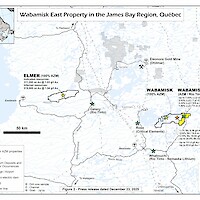
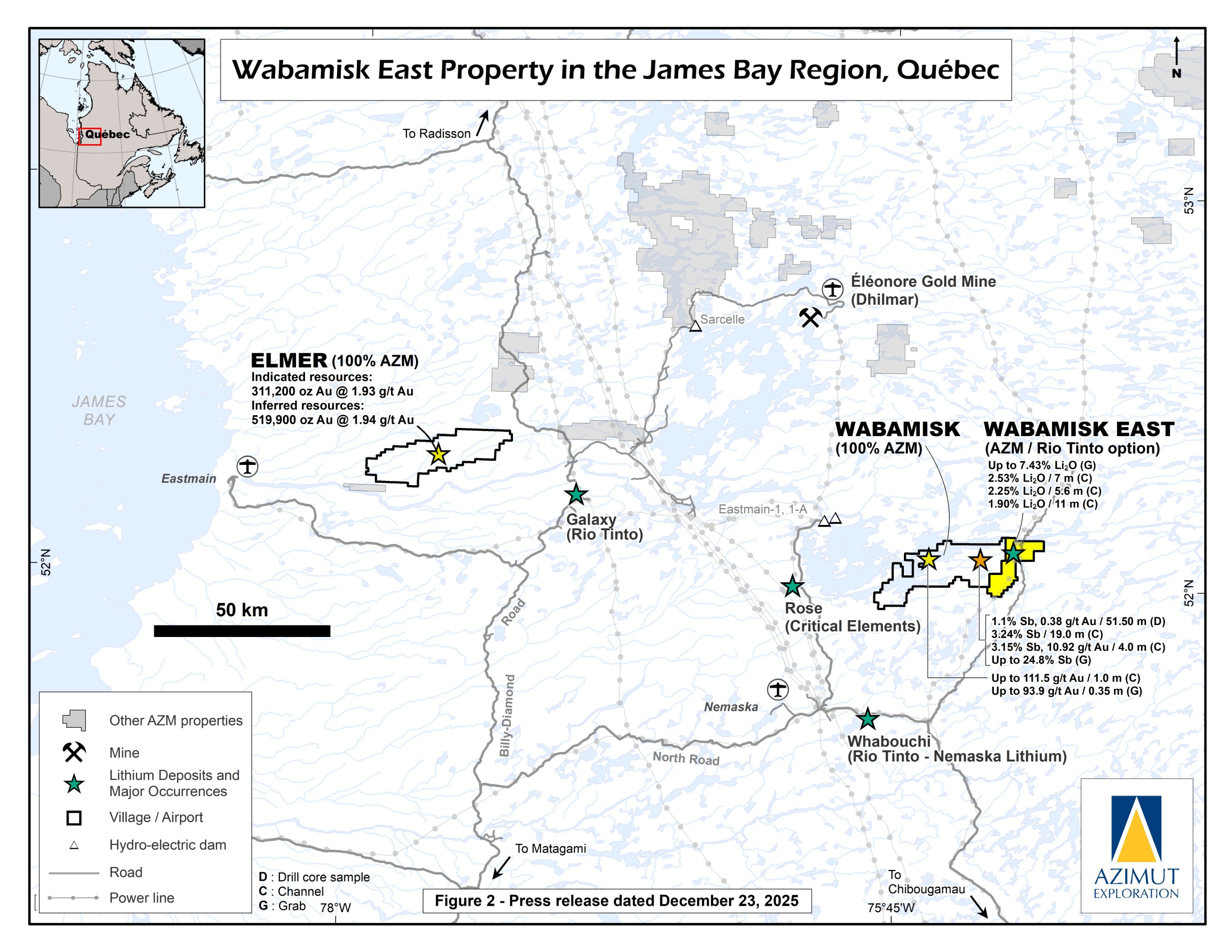
The newly formed Wabamisk East property corresponds to the eastern part of Azimut’s wholly owned Wabamisk property and is located 42 km northeast of the Whabouchi property (Nemaska Lithium Inc.). Major powerlines pass through or close to the property's eastern end, and the North Road highway passes 37 km to the south. The nearest town is Nemaska, a Cree community, 55 km to the southeast.
Azimut initially acquired the claims by map designation in 2005 following its James Bay-scale predictive modelling for gold. Wabamisk was optioned to Placer Dome in 2005 before it was transferred to Goldcorp Inc. which was then acquired by Newmont. In 2022, Azimut announced that it regained 100% ownership of the project (PR of August 8, 2022).
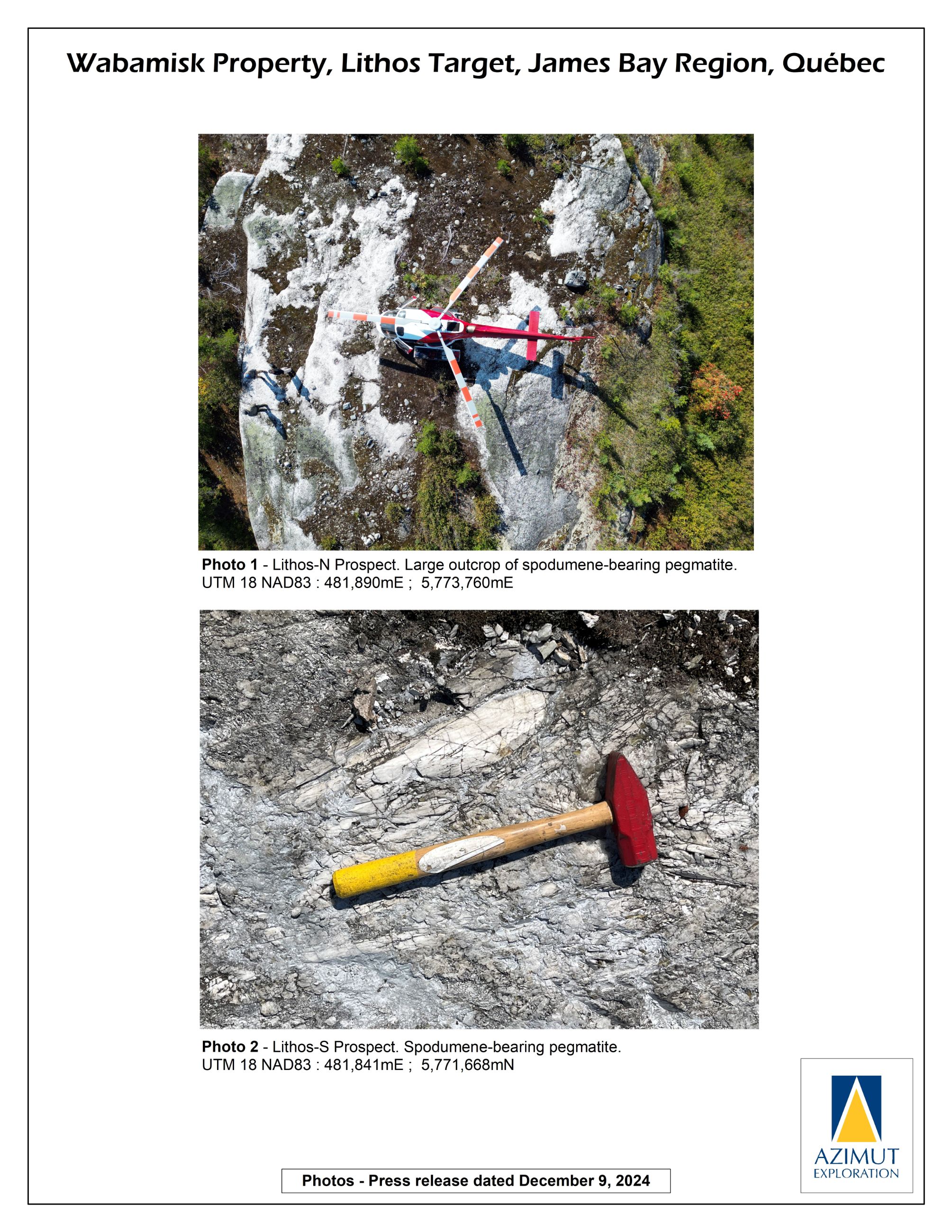
Since regaining full control of the Property, Azimut reprocessed the property’s large database to rank exploration targets. The 2024 prospecting program revealed an antimony-rich system but also a strong potential for lithium, with an extensive spodumene pegmatite field identified.
In July 2025, it announced that it revised its agreements (the "Revised Agreement") with Rio Tinto Exploration Canada Inc ("Rio Tinto") to consolidate the previous agreements and to cover three properties – Corvet, Kaanaayaa and Wabamisk East (together the “CKW Properties”) (PR of July 24, 2025). The agreeement was terminated at the end of 2025.
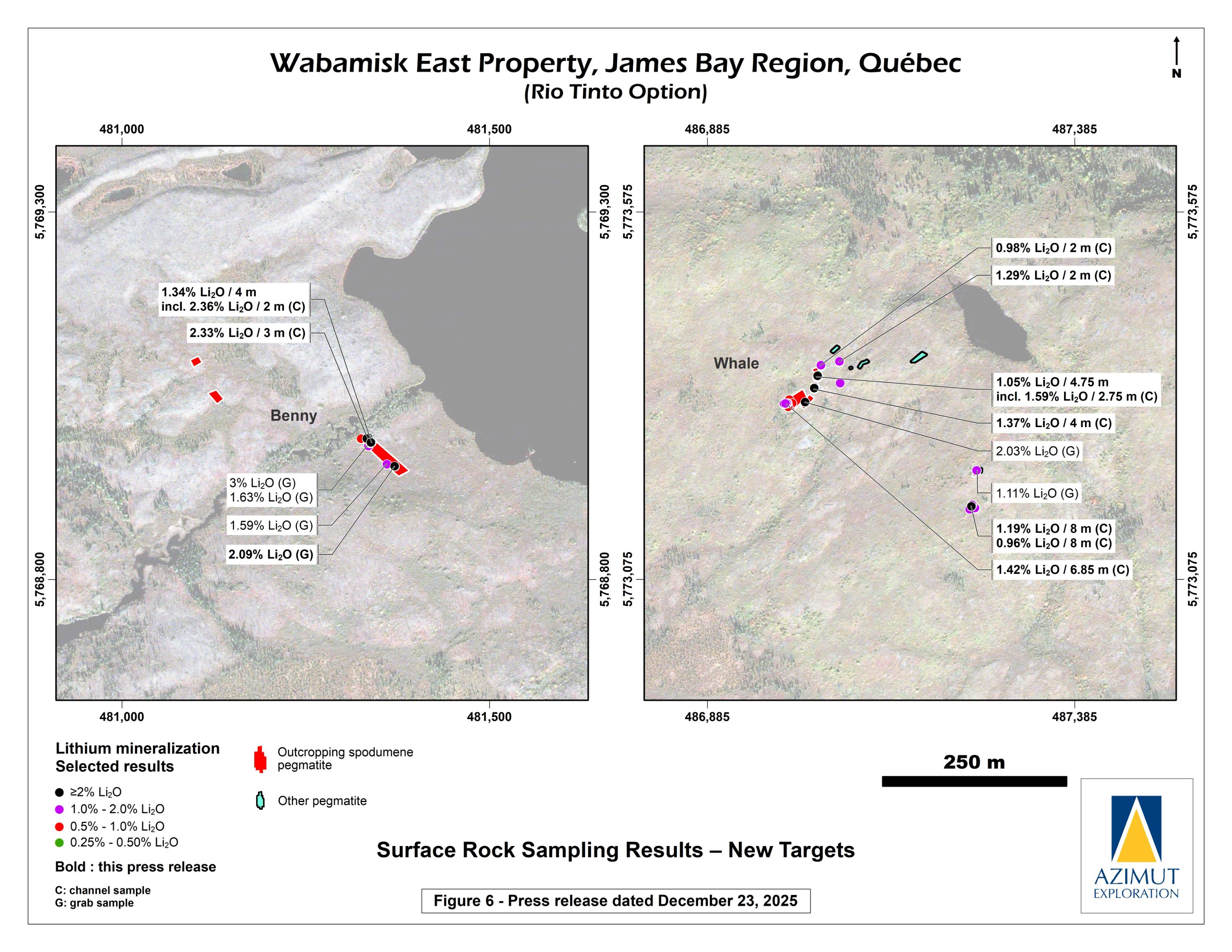
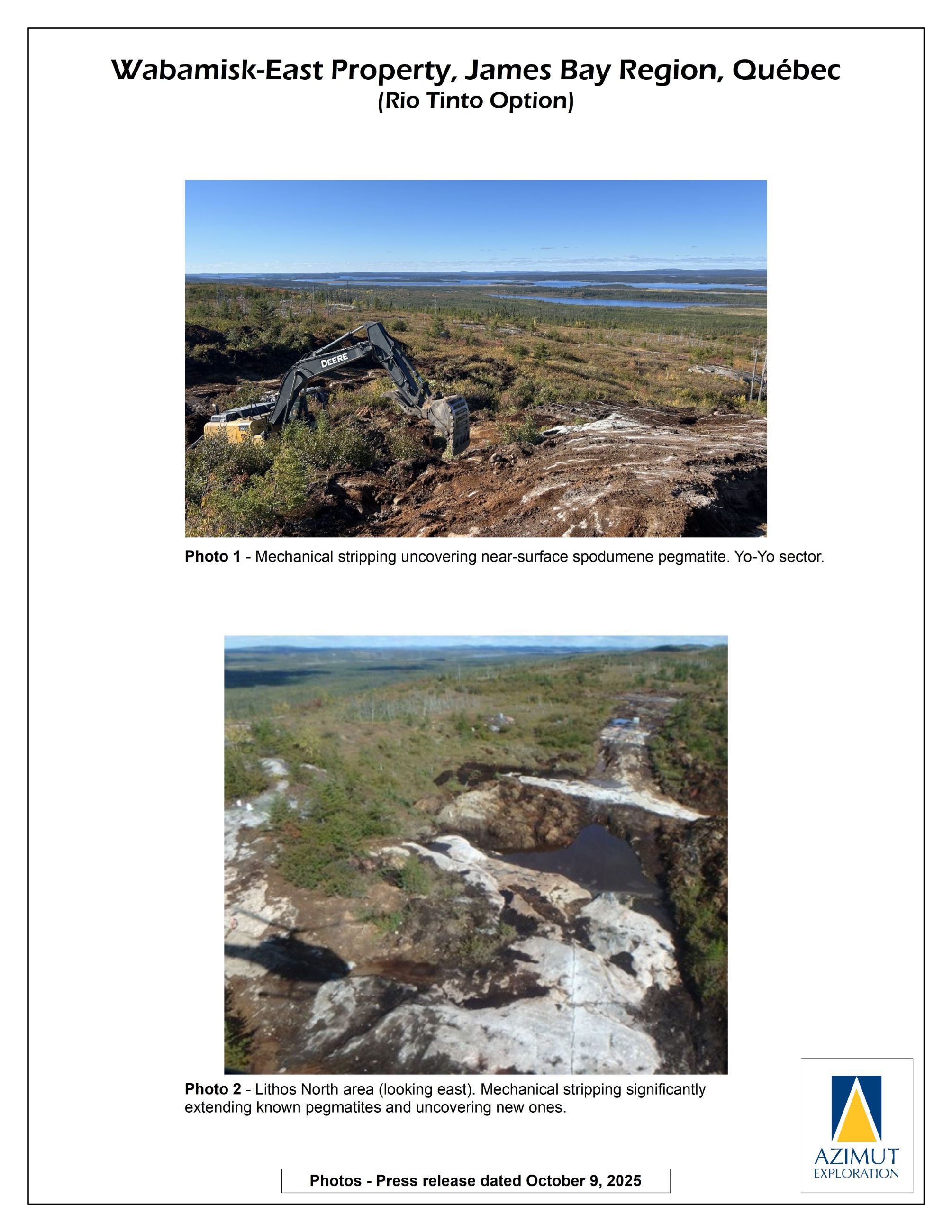
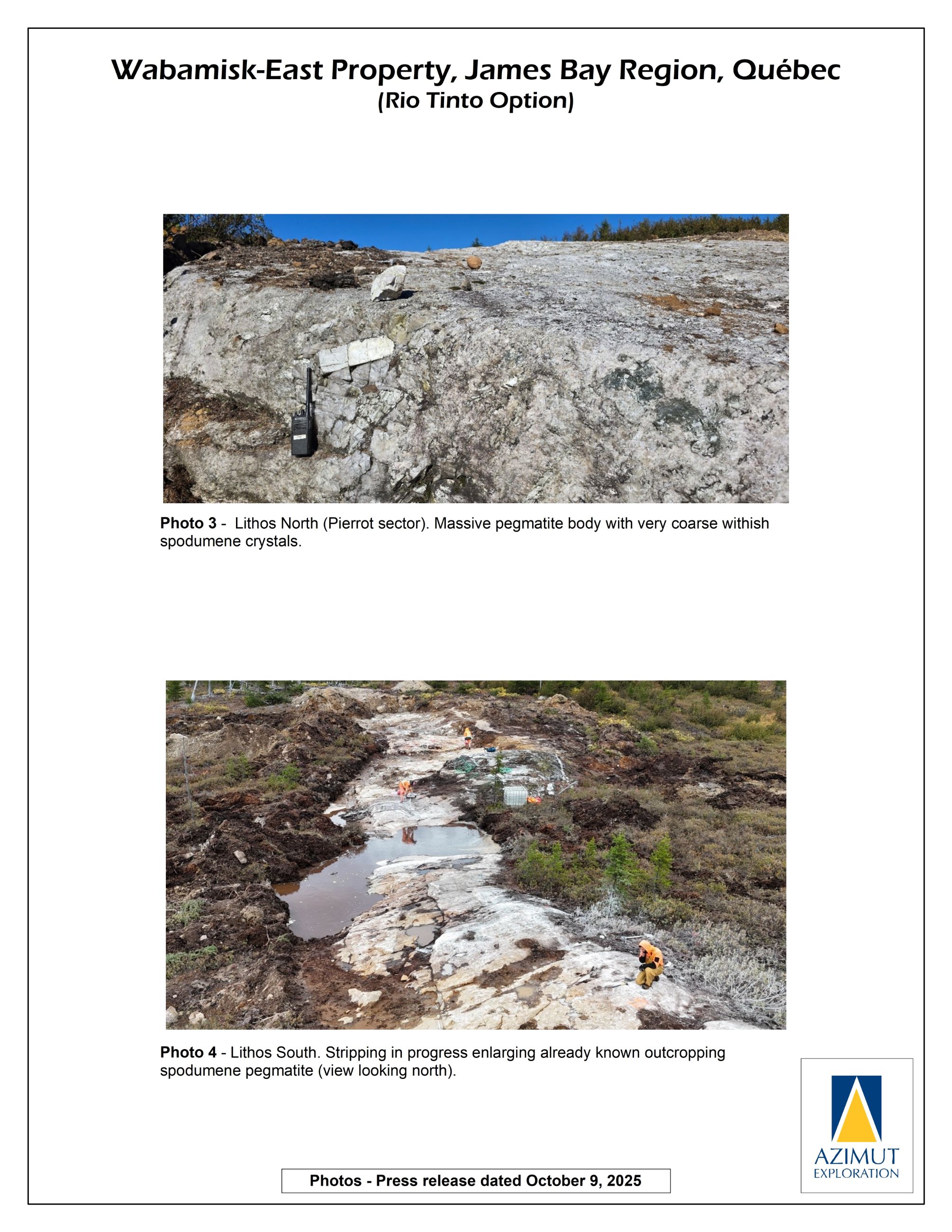
Azimut reported the positive results from a systematic field program conducted on its Wabamisk East property (see press release dated October 9, 2025 and December 23, 2025).
The 2025 field program has significantly enhanced the lithium potential of the property by further defining a high-grade, multi-kilometre-scale spodumene pegmatite field. Wabamisk East is regarded by Azimut as offering excellent exploration potential.
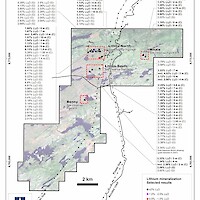
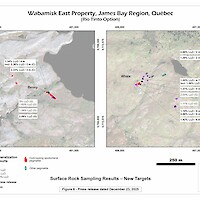
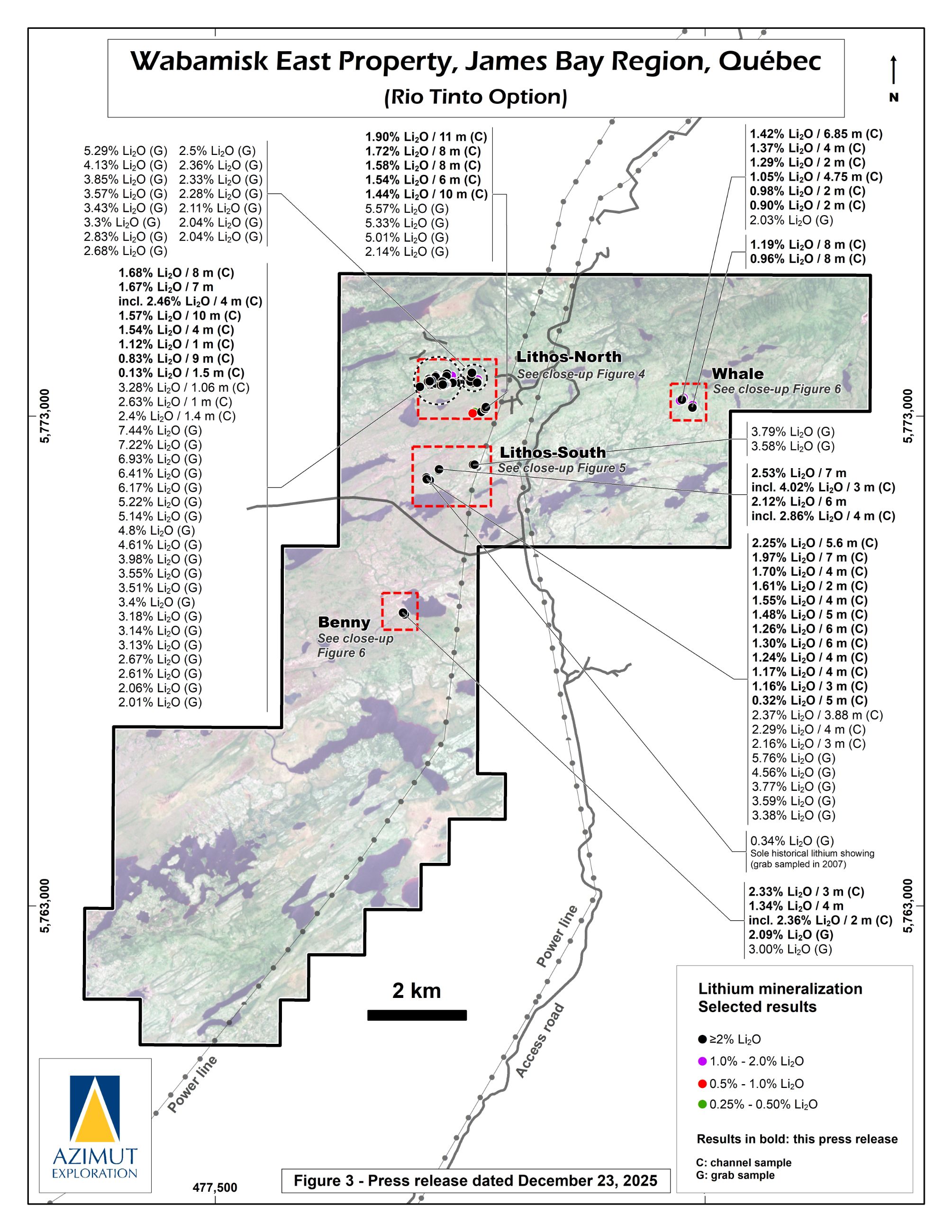
At least 138 distinct spodumene-bearing outcrops have been identified and sampled since the initial 2024 field check of an isolated historical grab sample grading 0.34% Li2O. The pegmatite field remains open in all directions. There is good potential for additional discoveries of spodumene pegmatites under cover within a minimum 4-km2 prospective surface area.
Of the 493 samples (162 grabs, 331 channels) collected since 2024, 340 returned grades higher than 0.5% Li2O for an average grade of 1.94% Li2O :
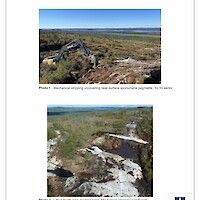
Five diamond drill holes (totalling 615 m) have tested three outcropping targets, with significant spodumene-bearing intervals intercepted at Lithos North 1, Pierrot and Lithos South. The Company considers this to be a limited initial drill testing phase. Numerous high-grade outcropping targets are drill-ready, and a more substantial follow-up phase is warranted for 2026.
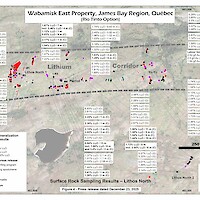
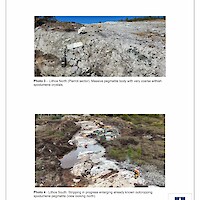
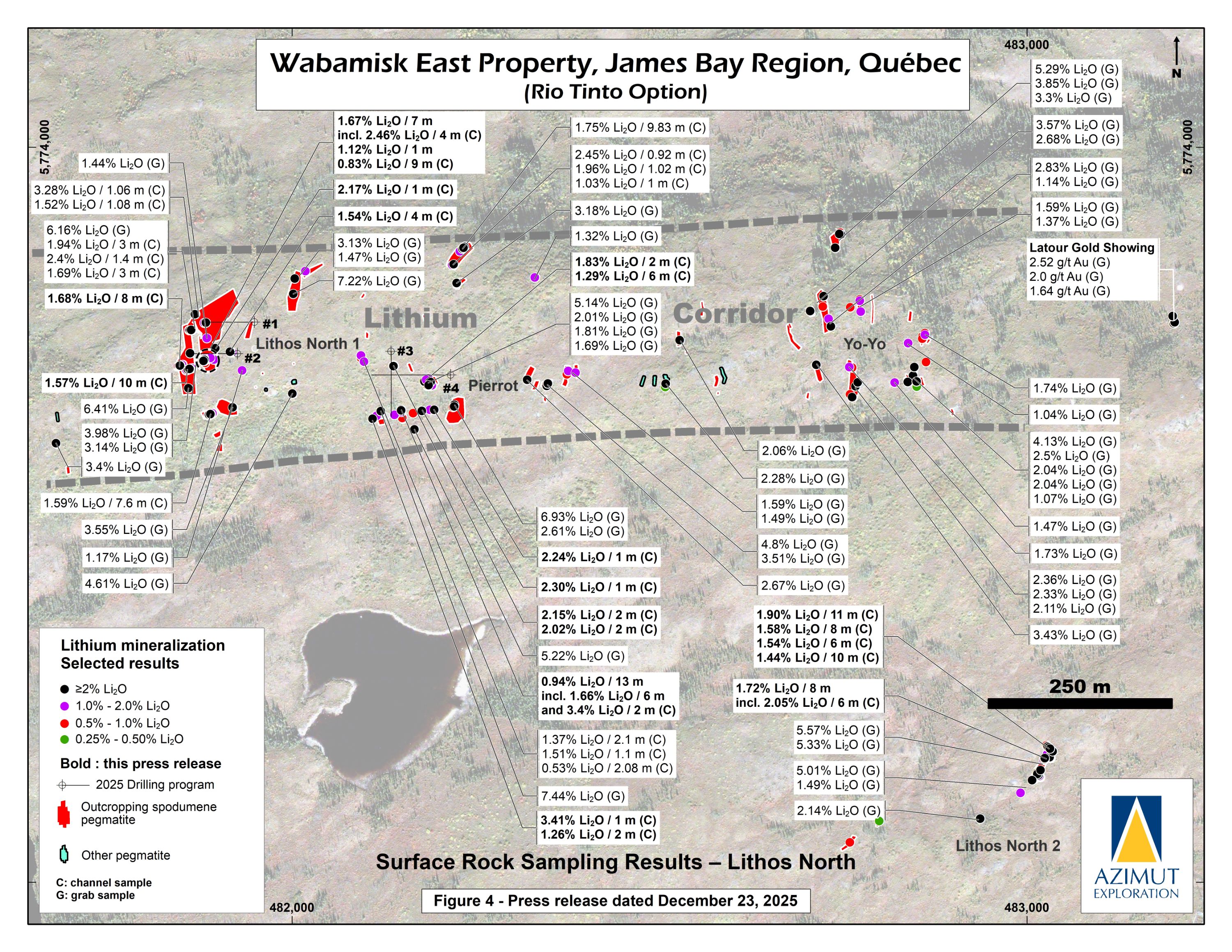
At Lithos-North, the pegmatite bodies have a roughly N-S orientation (ranging from N350° to N20°) with dips to the east ranging from 60° to 75°. These bodies have variable apparent thicknesses (ranging from 10 to 50 m or more), and they cut across sheared mafic metavolcanics striking E-W. They form an en echelon field of intrusive bodies along a 1.2-kilometre-long and at least 250-metre-wide E-W corridor (the “Lithium Corridor”). Other orientations and dips have been observed, including possibly stacked shallow-dipping E-W-striking pegmatites (at Pierrot), which may be connected to N-S bodies.
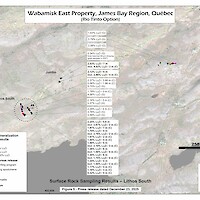
At Lithos South, the pegmatite bodies display similar northward orientations and eastward dips as those at Lithos North. Apparent thicknesses observed to date range from 10 to 15 m. These pegmatites may define a second E-W lithium corridor.
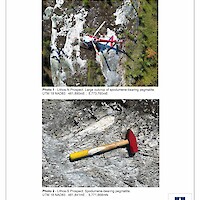
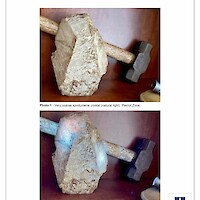
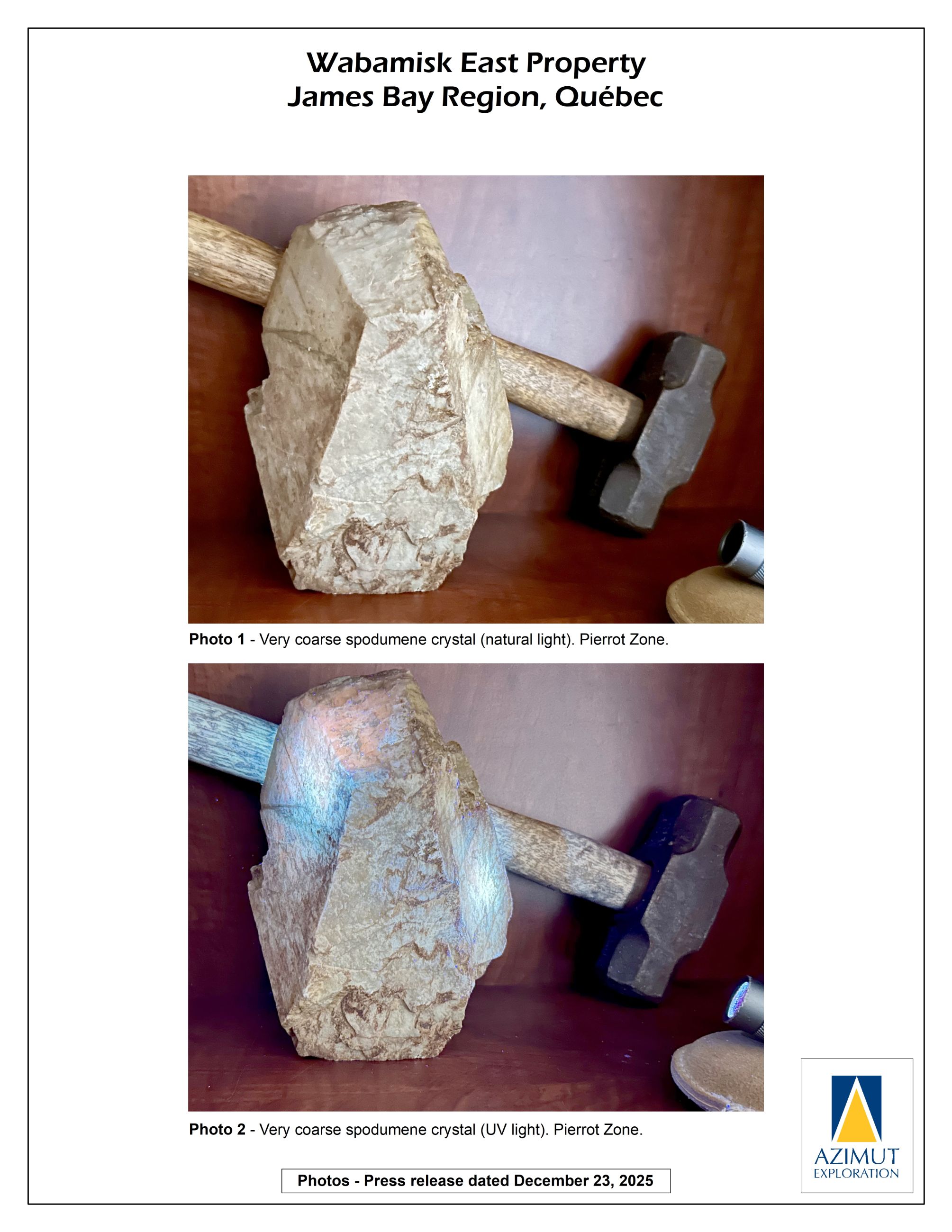
Spodumene crystals are generally coarse to very coarse (up to 1.0 m), whitish or greyish to greenish, accompanied by quartz, white feldspar, muscovite, apatite and black tourmaline. Holmquistite (a diagnostic lithium-bearing amphibole) has been observed in the surrounding host rocks (mostly mafic metavolcanics and gneissic metasediments) proximal to the spodumene pegmatites.
The Wabamisk property is situated in the Archean Superior Province at the contact between the La Grande and Opinaca subprovinces. This boundary is controlled by a major E-W regional deformation corridor. The property is underlain by La Grande volcano-plutonic lithologies and Opinaca metasedimentary units.